
To check a car’s chassis number, compare the identifier on the vehicle with its registration documents and the VIN printed on every report you receive. Then use an appropriate decoder or record service for the question you need to answer.
A matching VIN helps establish that the documents relate to the car in front of you. It does not, by itself, prove accident history, ownership rights, outstanding finance or present mechanical condition.
Where to find the number
Use the vehicle handbook to locate its identification markings. Common locations include a plate visible through the windscreen and a label in a door opening; a stamped chassis identifier may be elsewhere. Locations differ between models. Compare accessible identifiers without removing trim or altering labels.
What a VIN decoder can tell you
Many modern vehicles use a 17-character VIN. Older vehicles and some market-specific chassis-number formats need manufacturer guidance, so a different format should not be judged from a generic decoder alone.
The NHTSA VIN decoder displays vehicle information reported by manufacturers, including available manufacturing details. It is a useful reference for supported vehicles, especially US-market imports. It is not an accident-history or ownership-clearance service.
Do not assume every VIN position has the same meaning in every market. If the decoded model, engine or year appears inconsistent, first check the entered number and then ask the manufacturer or authorised dealer to explain the discrepancy.
Three different questions
- Identity: does this vehicle match these documents?
- History: what events are recorded by the selected source?
- Condition: what does an inspection find today?
Answering one does not automatically answer the other two.
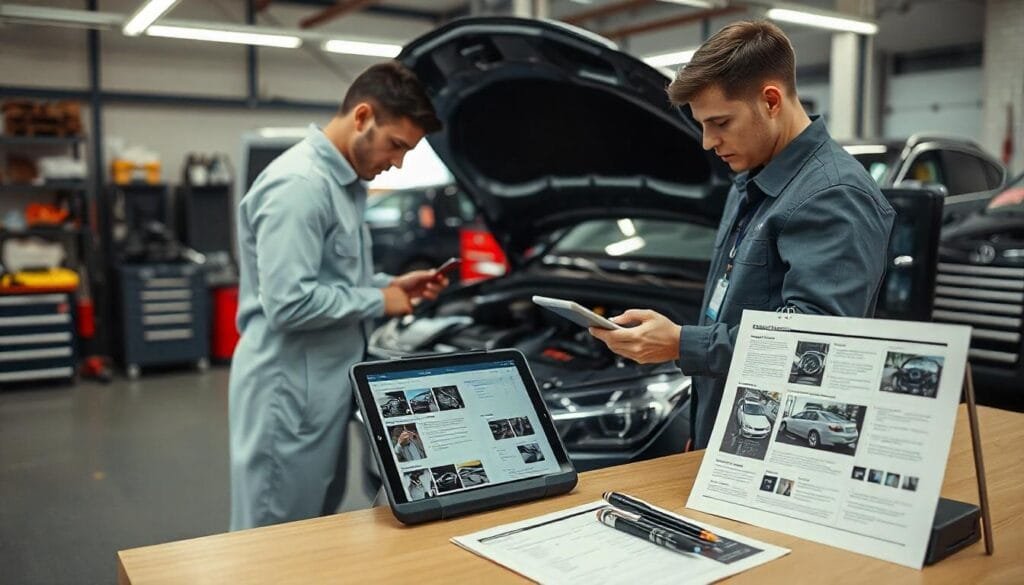
Check the VIN step by step
- Copy it carefully. Compare the complete identifier rather than only its last few characters.
- Match the documents. Check registration, invoices and reports for the same number. Ask the seller to explain differences.
- Check the source. Open the official service yourself where possible. Confirm what it searches and whether owner consent is needed.
- Review available history. Look for inconsistent dates, mileage entries or vehicle descriptions. Ask for supporting documents.
- Arrange a condition inspection. Share unresolved questions before the appointment so the scope can address them.
For Dubai vehicle information, read the description of the RTA Technical Vehicle Status Report. It requires owner agreement and is not an accident-data report. For accident-record options and their limitations, use our UAE accident-history guide.
What to do when details do not match
A mismatch needs an explanation before money changes hands. It might be a transcription error, an incorrect report or a more serious identity concern. Do not assume which one without checking.
Ask the seller to provide the original document and obtain clarification from its issuer. Where markings appear altered, missing or inconsistent, stop the purchase process and seek verification through the relevant authority or manufacturer. Do not scrape, restamp or modify an identification marking yourself.
Check financial and ownership restrictions through the relevant lender and official transfer process. A decoder result or generic VIN lookup does not establish that the car is free of finance or ready to transfer.
For an imported car
Compare the UAE documents with the available export, import and previous-country records. If a report uses another unit for distance, note that before comparing mileage. Missing overseas history remains a gap even when the UAE identifiers match.

Questions about chassis-number checks
Is a chassis number always the same as a VIN?
The terms are often used together, but vehicle age and market affect the identifier’s format. Use the manufacturer’s terminology and the number recorded on the official vehicle documents.
Does decoding the VIN reveal every accident?
No. Decoding identifies supported vehicle characteristics. Accident records come from separate sources with their own coverage and limitations.
Can the VIN confirm that a car is not stolen?
A general decoder cannot provide that assurance. Refer an identity concern to the relevant authority and follow the official ownership-transfer checks.
Do I still need a pre-purchase inspection?
A pre-purchase inspection examines the agreed aspects of present condition. That remains a separate task from checking identity and records.