
Trace the circuit before replacing the part
Car electrical diagnostics in Dubai
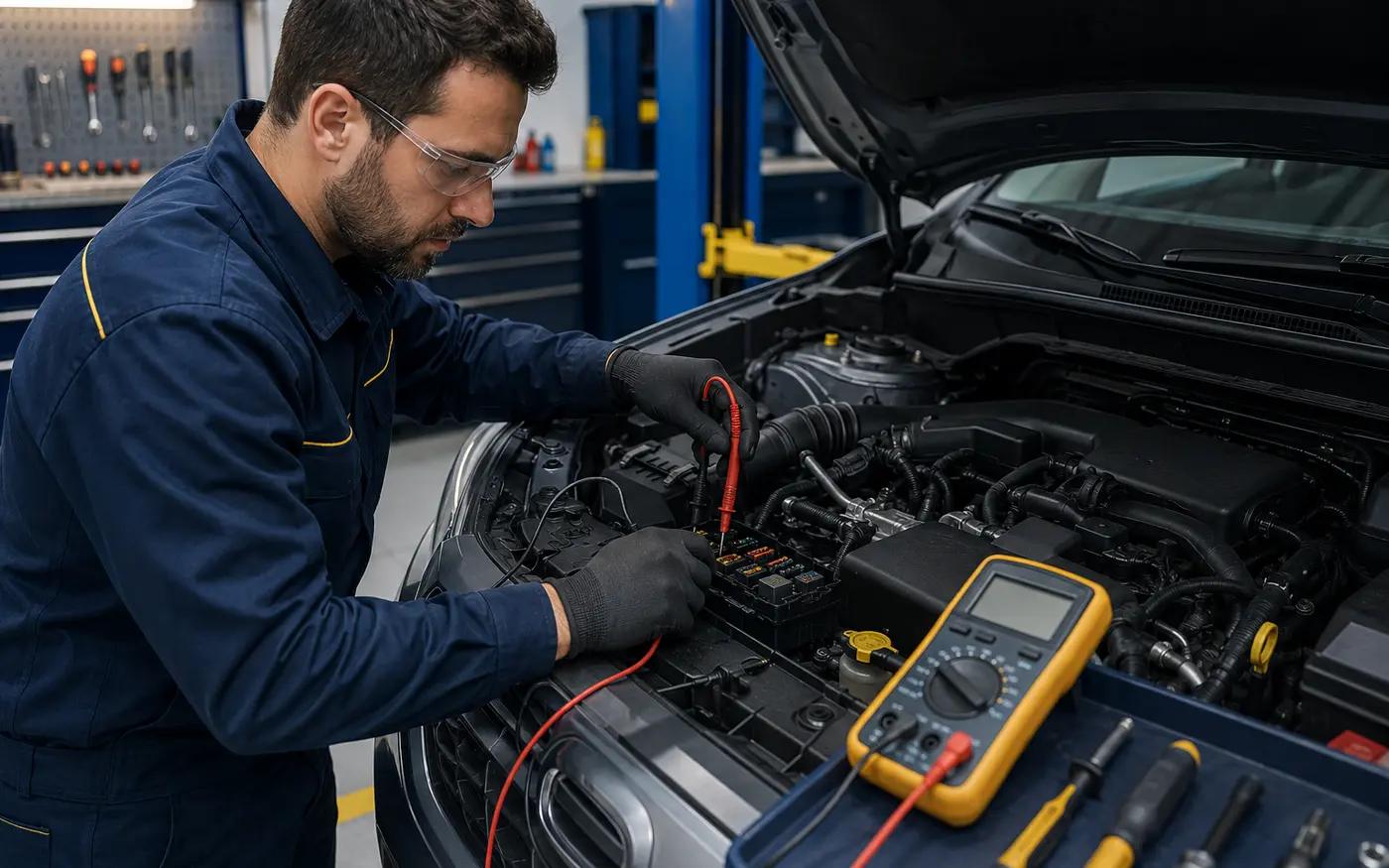
Electrical diagnostics investigates the symptom by checking relevant power supplies, wiring, connections, control signals and components. A warning or fault code helps identify the affected system; further tests establish which part of the circuit is causing the problem.
Tests compare the command, power supply, wiring, component and ground under the conditions in which the fault occurs.
First decision
Decide whether the vehicle should move before testing
Electrical faults range from an isolated convenience problem to a condition that can disable steering assistance, braking support, lighting, charging, or powertrain control. The warning message, smell, heat, smoke, starting behavior, and systems affected determine the first action.
Do not assume a vehicle is safe because it still starts. A damaged high-current cable, repeated main-fuse failure, overheating connector, charging fault, or water-affected control area can deteriorate without a predictable warning.
Use recovery if there is smoke, a burning smell, visible arcing, a hot or melting cable, repeated main-fuse failure, loss of essential lights at night, multiple safety systems dropping out, or the engine stalls with a charging warning.
Arrange prompt diagnosis for intermittent starting, recurring battery discharge, flickering exterior lights, sporadic warning messages, slow windows, or accessories that operate unpredictably.
A stable non-safety convenience fault may allow a scheduled assessment, but record when it occurs and avoid repeatedly operating a stalled motor, jammed window, or suspect accessory.
Electrical fault isolation
Car electrical diagnostics follow the whole circuit
An electrical load works only when every part of its path supports it. A healthy battery cannot overcome a corroded ground. A correct control command cannot operate a motor with excessive internal resistance. A new component will not fix a damaged connector that loses voltage under load.
The useful question is not simply “Which part has a code?” It is “Where does the expected electrical behavior stop matching the actual behavior?”
Supply
Battery state, charging support, terminal condition, cable integrity, and available voltage create the electrical source for the circuit.
Protection
Fuses, fusible links, circuit protection, and distribution points must carry the intended load without opening or developing excessive resistance.
Command
A switch, control module, network message, sensor input, or programmed condition requests the component to operate.
Load
The motor, lamp, heater, solenoid, relay coil, actuator, or control unit must respond while drawing a plausible amount of current.
Return
The ground path and connections must complete the circuit without a voltage drop that changes when vibration, temperature, or load changes.
If the test checks only the load, it can miss a weak supply, poor ground, damaged terminal, unwanted resistance, incorrect command, network problem, or a fault that exists only when the circuit is operating.
Symptoms and checks
The complaint narrows the branch, not the replacement part
One symptom can have several electrical and non-electrical causes. The confirming test should reproduce or measure the fault before a repair decision is made. This matrix shows the reasoning relationship, not an automatic diagnosis.

A diagnostic ledger
How an electrical fault is investigated
The diagnostic order changes with the vehicle and complaint, but the logic should remain traceable. Car electrical diagnostics are stronger when each conclusion explains which observation or measurement supports it and which alternatives were ruled out.
Define the exact failure
Record what does not work, what still works, whether the fault is constant or intermittent, and what happened immediately before it began. A “dead battery” complaint may actually mean no crank, slow crank, no start, loss of key recognition, or a discharged battery after parking.
Check the electrical supply first
Battery condition, terminal contact, system voltage, visible cable condition, and relevant fuses need context before interpreting control-module data. Low or unstable voltage can create secondary faults across unrelated systems.
Read supported electronic information
A vehicle-wide scan may show which modules communicate, which faults are current or stored, and whether live data matches the complaint. Codes should be recorded before clearing because clearing may remove useful timing, frequency, or freeze-frame context.
Test the affected circuit under realistic load
Continuity with the circuit switched off does not always reveal resistance that appears under load. Depending on the fault, the useful evidence may include voltage drop, current behavior, supply integrity, ground quality, command status, pin fit, or comparison with a working side.
Inspect wiring and connections
Harnesses can rub, stretch, trap water, suffer heat damage, or be disturbed by previous work. Connectors may look clean while a terminal is loose, backed out, overheated, or unable to carry the required current.
State the finding and its limit
A useful finding can identify a confirmed fault, a most-supported cause that needs deeper access, or an unresolved intermittent condition. It should not present a guess as proof or promise that unrelated hidden faults are absent.
Systems and entities
Electrical faults can begin outside the component that stops working
Modern vehicles distribute power and decisions across batteries, wiring, switches, sensors, modules, networks, relays, actuators, and grounds. The affected feature helps identify the system, but shared circuits and communication mean the first visible failure may be downstream from the cause.
Battery, charging, and starting
This area includes the 12-volt battery, terminals, battery monitoring where fitted, alternator or integrated starter-generator on applicable vehicles, starter circuit, main cables, grounds, and power distribution. Battery replacement does not correct an unresolved drain, poor connection, or charging-control problem.
Wiring, connectors, and protection
Harness routing, splices, terminal tension, seals, fuse boxes, relays, fusible links, and distribution points can create open circuits, short circuits, heat damage, or unwanted resistance. Previous repairs and accessory wiring deserve careful context.
Control modules and networks
Modules exchange commands and status over vehicle networks. A communication code may come from power loss, ground loss, wiring, network disturbance, another module, or the module named in the code. Programming and replacement requirements vary by vehicle.
Safety-related electronic systems
ABS, stability control, airbags, electric steering assistance, powertrain management, exterior lighting, and driver-assistance features can all present as electrical complaints. These systems require dedicated safety decisions and relevant diagnostic procedures. Use the warning-light diagnostic guide for indicator context and the specific brake, steering, or airbag service when the fault involves those systems.
Body and convenience electronics
Windows, locks, mirrors, seats, wipers, wash systems, parking aids, cameras, tailgates, interior lighting, climate-control commands, and keyless functions may involve both electrical and mechanical causes. A stalled mechanism can overload a healthy motor or circuit.
Infotainment and communication
Displays, audio, navigation, phone integration, USB power, amplifiers, antennas, and software-controlled interfaces can fail through supply, communication, configuration, hardware, or external-device problems. A frozen screen does not automatically mean the display assembly has failed.
Hybrid and electric vehicle boundaries
The low-voltage system can affect contactor control, wake-up behavior, charging communication, and multiple warnings, but orange high-voltage circuits require vehicle-specific procedures, suitable equipment, and trained personnel. A general inspection must not be presented as a complete high-voltage battery or isolation diagnosis unless that scope is specifically confirmed.
Choose a suitable test location
Mobile checks and workshop testing answer different questions
If you searched for car electrical diagnostics near me, some symptoms can be assessed where the vehicle is safely parked. Other faults require stable power, lift access, extended observation, circuit information, controlled loads, dismantling, programming support, or specialist equipment at Al Quoz 4, Dubai. Confirm the expected setting and scope before the appointment.
What may be practical at the vehicle
- Confirm the reported symptom and record dashboard messages.
- Inspect accessible battery terminals, obvious cable damage, fuses, connectors, and affected functions.
- Read supported control modules and available live information.
- Check basic voltage behavior and compare related functions when conditions are safe.
- Confirm whether the car needs recovery, workshop testing or a separate specialist appointment.
Access, weather, traffic, lighting, parking permission, battery condition, network coverage, and the ability to keep the vehicle undisturbed can limit a mobile assessment.
What may need a workshop
- Parasitic-draw testing that requires the vehicle to complete its shutdown sequence.
- Safe access to concealed harnesses, distribution points, grounds, or underbody wiring.
- Controlled load testing, current measurement, extended heat or vibration observation, and circuit tracing.
- Removal of trim or components after approval.
- Vehicle-specific programming, coding, calibration, high-voltage work, or specialist bench testing when supported.
A workshop still cannot guarantee that an intermittent fault will occur during the appointment. Some findings require a staged test plan or return visit under the conditions that trigger the complaint.
Conditions that change the test strategy
Intermittent faults need the conditions that make them appear
A fault that occurs once a week cannot always be confirmed during a short appointment. The aim is to preserve useful clues, identify common circuits, and reproduce the condition only when doing so is safe and proportionate.
Note whether the failure appears after a hot soak, long drive, traffic, air-conditioning use, or repeated operation. Resistance, internal electronics, relays, motors, and connections can behave differently as temperature rises.
Water can enter through seals, drains, body repairs, windshield work, lamps, roof systems, or damaged connector protection. Do not flood an area to recreate the issue. Record the weather and inspect for supported moisture evidence.
Record how long the vehicle was parked, whether it was locked, which keys were nearby, and whether a charger, tracker, dash camera, or accessory was connected. A correct draw test may need time for modules to enter their normal sleep state.
Paintwork, dashboard removal, door work, windshield replacement, engine work, audio installation, and collision repairs can disturb grounds, harnesses, connectors, sensors, and module configuration. Share invoices or the repaired area if available.
Trackers, alarms, cameras, lighting, remote-start systems, audio amplifiers, chargers, and wiring adapters can introduce current draw, network disturbance, poor splices, shared-circuit overload, or routing damage. Their presence is evidence, not automatic proof of blame.
Tell the inspector if the vehicle was recently jump-started, connected to a charger, or had battery terminals disturbed. Do not keep repeating jump starts when cables heat, protection devices fail, or the reason for discharge is unknown.
Cost follows fault isolation
Electrical diagnostic prices
Inspector’s current booking page lists warning-light or component diagnostics at AED 200 to AED 500. That range provides context, but an electrical concern still needs the exact vehicle, symptom, location, access, included tests, and report output confirmed before it can be quoted.
A simple visible connection issue and an intermittent network fault requiring staged testing are not equivalent jobs. Diagnosis can lead to a wiring repair, connector service, battery or charging decision, motor or actuator repair, module testing, programming requirement, or a referral for a system outside the agreed capability.
General guide for warning-light or component diagnostics. Ask whether your electrical fault fits this assessment and which tests are included.
Intermittent drain, concealed wiring, network faults, dismantling, extended observation, programming, and specialist tests can require a separately defined scope.
Repair cost depends on the confirmed layer, access, labor, wiring or connector work, part choice, programming, calibration, retesting, and current parts availability.
The published range is indicative and non-binding, not a final quotation. Ask for a written estimate based on the exact vehicle, symptom, diagnostic scope, location, access, required work, parts choice, VAT treatment, and current conditions.
What to bring
Give the diagnostic process a better starting point
You do not need to dismantle the vehicle or test live circuits yourself. A clear description of the event can save time and help select the correct first test.
Share the make, model, year, engine or powertrain, market specification, and any recent battery or electrical work.
Describe exactly what failed, what remained operational, and whether the vehicle started, cranked, stalled, or displayed a warning.
Record when it happens, including temperature, rain, parking duration, road vibration, steering movement, door use, or accessory operation.
Photograph dashboard messages and take a short video of intermittent behavior only when the vehicle is safely parked.
Bring previous scan reports, battery test information, repair invoices, accessory details, and a list of parts already replaced.
Confirm where the vehicle is parked, whether it can be moved safely, and whether workshop recovery or deeper access may be needed.
Repair decision
A repair is complete only when the original complaint is retested
Electrical work should close the evidence loop. A repaired wire that still has excessive voltage drop, a replacement battery with an unresolved drain, or a cleared code without restored operation does not close the complaint.
Confirm
Reproduce or measure the original symptom and record the conditions in which it appears.
Isolate
Identify the supported circuit, connection, command, load, network, software, or mechanical cause.
Correct
Repair, replace, secure, program, or refer only the work supported by the confirmed finding and agreed scope.
Retest
Repeat the relevant functional and electrical tests, review fault information, and document any remaining limits.
Restoring a failed supply or network can allow previously offline modules to communicate and disclose additional faults. That does not automatically mean the first repair was wrong. The next decision should be based on the new evidence and separated from unrelated stored history.
Questions before booking
Car electrical diagnostics questions
What is included in car electrical diagnostics?
The scope can include symptom confirmation, battery and supply context, supported module scanning, accessible fuse and connector inspection, circuit testing, and a recommended next step. The exact tests depend on the vehicle, complaint, location, access, and agreed service.
Does a fault code identify the failed part?
Not by itself. A code usually identifies a circuit, signal, communication issue, operating condition, or monitored performance problem. Power, ground, wiring, connectors, commands, mechanical conditions, and other modules may still need testing.
Can a healthy battery still go flat overnight?
Yes. A battery can discharge because of an unwanted load, a module that does not enter sleep mode, lighting, accessories, wiring, or charging use. Battery condition and the reason for discharge should be evaluated separately.
Why does the problem disappear at the workshop?
Intermittent faults may depend on heat, moisture, vibration, parking duration, door or key activity, or a specific load. Videos, event timing, scan history, and a staged test plan can help when the symptom does not occur during the appointment.
Can electrical diagnosis be completed at my location?
Some symptom checks, supported scans, accessible inspections, and basic measurements may be practical at a suitable parked location. Parasitic draw, concealed wiring, dismantling, programming, high-voltage work, or extended controlled tests may require a workshop or separate specialist scope.
Should I replace the battery before diagnosis?
Replace it only when its condition supports replacement or when safe testing requires a known-good supply. A new battery can temporarily hide a drain, charging, terminal, or wiring problem and may fail again if the root cause remains.
How long does electrical fault finding take?
There is no reliable universal duration. Time depends on whether the fault is present, circuit access, vehicle shutdown behavior, the number of affected systems, technical information, testing depth, and whether programming or specialist work is required.
Can diagnostics guarantee the fault will not return?
No inspection can guarantee future reliability or reveal every concealed intermittent fault. A strong diagnosis documents what was observed, what was tested, what was confirmed, what work was completed, and which limitations or monitoring instructions remain.
Is a general scan enough for airbag, brake, or steering warnings?
A general scan can provide context, but safety-system warnings may need dedicated procedures, physical checks, and safe-to-drive decisions. Use the relevant airbag diagnostics, brake diagnostics, or steering diagnostics service.
How do I book the right tests?
Send the vehicle details, exact symptom, warning messages, event conditions, recent work, location, and whether the car can move safely. The online inspection booking page provides a practical starting point.
Tell us what has happened
Describe the failure before choosing the repair
Share what stopped working, when it happens, which warnings appeared, whether the vehicle can move safely, and any recent battery, wiring, accessory, water, collision, or repair history. Inspector can then help define whether the first step is mobile assessment, workshop testing, recovery, or a dedicated system diagnosis.
Prepared by the Inspector.ae Editorial Team. Vehicle-specific safety, testing, repair, programming, and high-voltage decisions require confirmation against the exact vehicle and agreed diagnostic scope.