
Find the cause of a steering problem
Car Steering Diagnostics Dubai
Heavy steering, pulling, vibration, noise or a warning can come from several parts of the car. Inspector checks the relevant steering components, assistance system, tires and suspension, then explains the findings and whether further testing is needed.
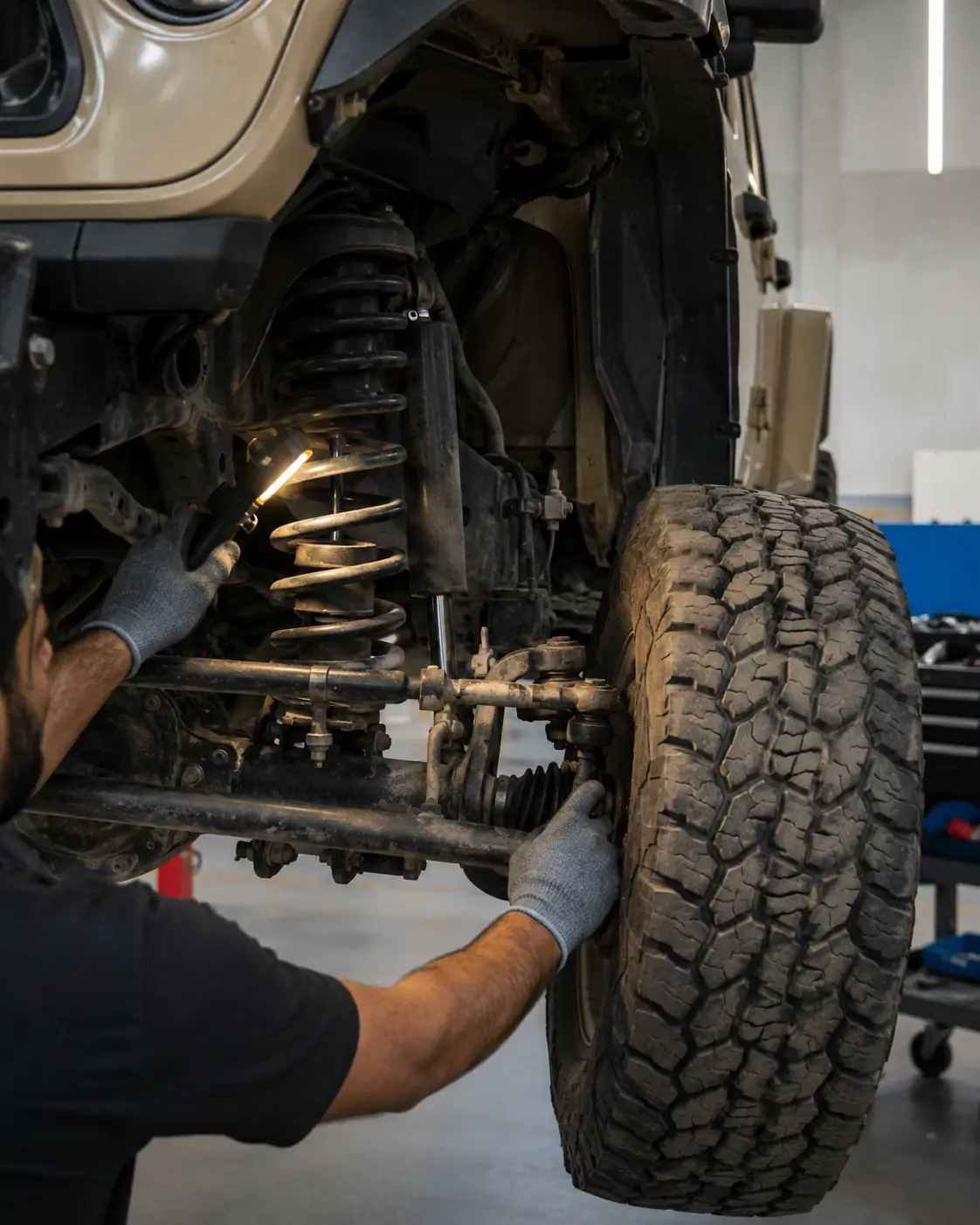
Start with the behavior
One steering complaint can have several sources
The column and steering gear transfer your input to the wheels through joints and tie rods. Hydraulic or electric assistance reduces the effort. Checking these connections and related components helps avoid replacing a rack or pump when the cause is elsewhere.
That is why replacing the most familiar part is not a reliable diagnostic method. A vehicle that pulls may have tire pressure variation, tire conicity, alignment error, brake drag, road-crown sensitivity, suspension damage, or an actual steering fault. A vibration may come through the wheel even when its source is a tire, wheel, axle, brake, or suspension component.
A useful diagnosis separates the symptom from the cause. It records when the behavior occurs, checks the basic conditions, inspects the load-bearing parts, reads relevant electronic data, and confirms the finding with a controlled test when it is safe to do so. The recommendation should explain the evidence and the next decision, not simply list stored fault codes.
Sudden change
Treat a sudden increase in effort, loss of response, binding, or impact-related change as urgent.
Speed related
Note whether the symptom appears while parking, at city speed, on a highway, or only during braking.
Direction related
Record whether it happens left, right, both ways, at full lock, or only while returning to center.
Surface related
Separate smooth-road behavior from tramlining, bumps, road crown, sand, or wet-road effects.
Diagnostic sequence
How a steering problem is checked
The sequence below is the page’s main decision path. A technician may change the order when the vehicle is unsafe, has collision damage, or requires model-specific procedures, but each stage answers a different question.
Describe
Capture the exact feel, sound, speed, temperature, direction, warning messages, recent repairs, tire work, curb contact, battery work, and collision history.
Stabilize
Confirm tire pressures and obvious wheel or tire damage. Look for fluid loss, loose hardware, damaged boots, and parts that could affect immediate control.
Measure
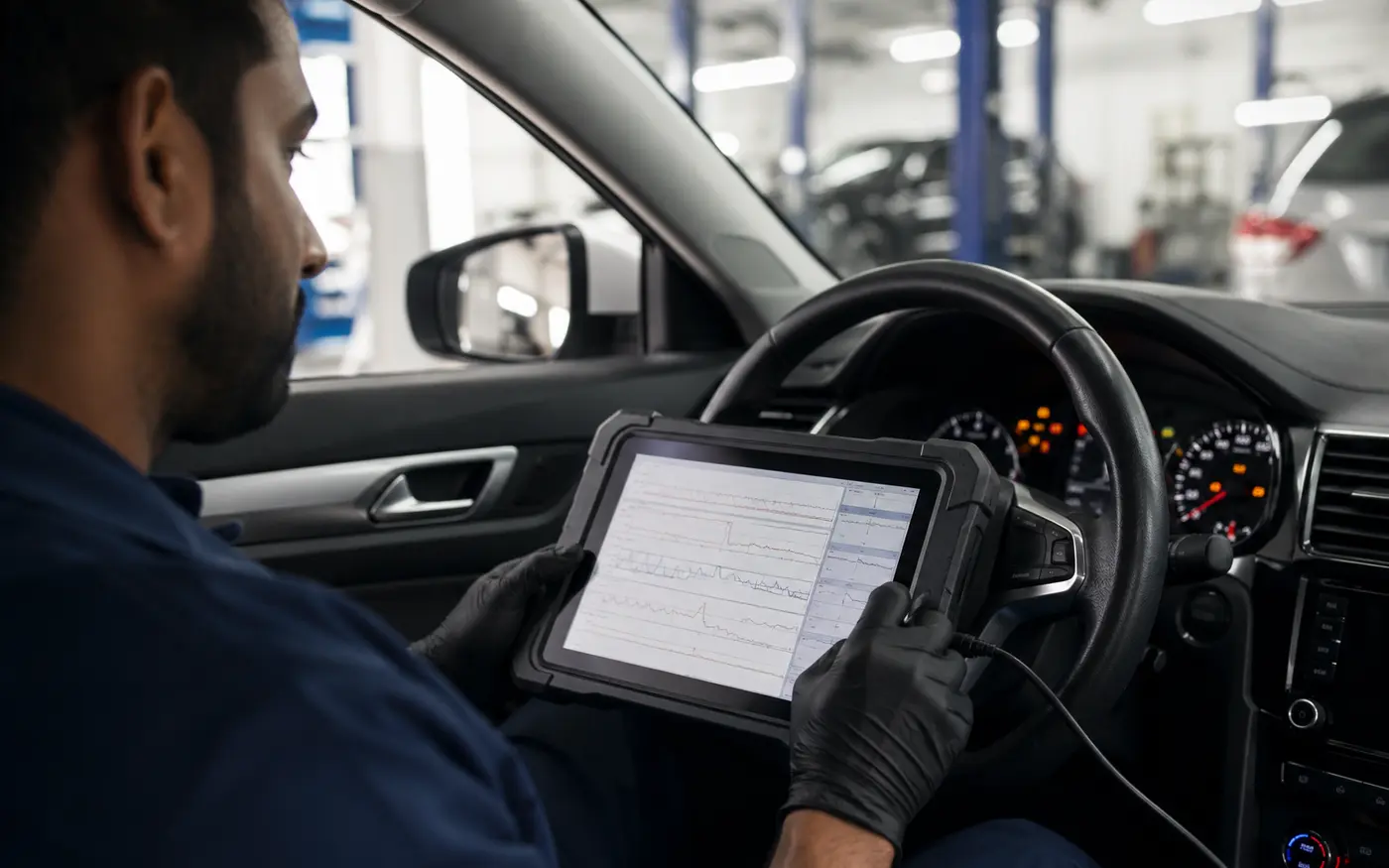
Check play, movement, assistance behavior, relevant supply voltage, fluid condition where applicable, alignment evidence, and scan data that relates to the complaint.
Load test
Observe the system while the symptom is reproduced safely. Static checks alone may miss faults that appear under road load, heat, speed, or steering angle.
Decide
Classify the result as confirmed fault, contributing condition, no fault found under test conditions, or further workshop testing required. Then define the safe next step.
Symptoms and checks
What the driver notices and what can confirm it
The same description can point to different systems. The comparison keeps possible causes separate from confirming checks and avoids automatic replacement advice.
Component coverage
Systems included in a complete steering assessment
Mechanical connection
The inspection follows movement from the steering wheel through the column, collapsible sections, intermediate shaft, couplings, universal joints, steering gear, rack mounts, inner and outer tie rods, steering arms, knuckles, and related fasteners. Wear, corrosion, impact marks, torn boots, displaced mounts, and abnormal movement can change response or create noise.
Hydraulic power steering
Hydraulic systems add a reservoir, specified fluid, hoses, seals, a pump, drive belt on many vehicles, valves, and pressure-assisted steering gear. Low level is evidence of fluid loss, not a complete diagnosis. Fluid appearance can support an inspection, but color alone does not identify every internal fault. Leaks must be traced to their highest wet point and assessed under appropriate conditions.
Electric and electro-hydraulic assistance
Electric power steering may place the motor and control unit on the column, pinion, or rack. It relies on stable electrical supply and inputs such as torque, steering angle, vehicle speed, and sometimes drive-mode commands. Electro-hydraulic systems use an electrically driven hydraulic pump. A scan must include related modules because battery, charging, stability-control, communication, and configuration faults can affect assistance.
Suspension, tires, brakes, and alignment
These systems are not interchangeable, but their symptoms overlap. Tires create the road force. Wheel alignment describes geometry rather than the health of every steering part. Suspension joints locate the wheels. A dragging brake can steer a vehicle under braking. When the evidence points outside the steering gear, a focused suspension diagnostic assessment or tire condition inspection can resolve the next decision. The diagnosis must show which system changes the direction or feel.
Advanced driver assistance and rear steering
Some vehicles use variable-ratio steering, active front steering, rear-wheel steering, lane-centering support, parking assistance, or steering-angle information shared with stability and driver-assistance systems. Diagnosis depends on exact model, year, market, options, software level, wheel and tire specification, and repair history. Calibration may be required after certain steering, suspension, alignment, collision, or battery-related work, but it should not be promised without checking the applicable procedure.
Mobile and workshop split
What can be checked where the car is parked
A mobile assessment can document the complaint, warning messages, visible damage, tire condition, fluid leakage, basic mechanical play, battery condition and accessible scan information. Customers searching for steering diagnostics near them can send the vehicle details, symptoms and location first. Inspector can then confirm whether mobile assessment is suitable or whether recovery to the Al Quoz 4 workshop is the safer option for lift-supported, alignment or controlled testing.
Mobile work has real limits. A parked vehicle may not safely reproduce a speed-related pull, intermittent loss of assistance, noise under chassis load, or vibration. Access underneath may be restricted. Accurate alignment measurement, wheel balancing, component isolation, hydraulic pressure testing, lift-supported inspection, and some calibration procedures generally require suitable workshop conditions.
A responsible result may therefore be “unsafe to drive, recover for testing” or “no fault confirmed during static inspection, workshop reproduction needed.” That is more useful than guessing from a fault code or selling a part before the behavior is verified.
Checks that may need a workshop
- Lift-supported joint and mounting inspection
- Four-wheel geometry measurement
- Wheel and tire runout or balance checks
- Controlled road-load reproduction
- Hydraulic pressure or flow testing when specified
- Electrical voltage-drop and current analysis
- Component isolation for mechanical binding
- Model-specific calibration and initialization
- Post-repair alignment and verification
- Comparative measurements across both sides
Repair decision
Findings should lead to a specific next step
A diagnostic report should state the complaint, conditions observed, checks completed, evidence found, limitations, safety classification, and recommended action. “Steering fault” is too broad. Useful findings identify whether the issue is mechanical looseness, binding, hydraulic loss, electrical supply, sensor plausibility, calibration, tires, alignment, suspension, brakes, collision damage, or an intermittent condition that still requires capture.
Define The Complaint
Record the behavior and the conditions in which it appears.
Confirm the cause
Separate mechanical, hydraulic, electrical, tire, alignment, and collision clues.
Choose The Action
Repair may involve tires, leaks, connections, joints, mounts, assistance components, alignment, or calibration.
Retest The Result
Recheck the original symptom, steering effort, warning status, alignment, and relevant live data.
Parts should not be replaced solely because a code mentions them. Likewise, clearing a warning light without correcting its cause is not a repair. After any repair, the original symptom should be retested under comparable safe conditions. If the vehicle uses steering information for stability control or driver assistance, the system should be checked according to the vehicle procedure.
Repair, Replace, Or Investigate Further
Some components can be serviced; others are replaced as assemblies because of design, safety requirements, parts support, or manufacturer procedure. The correct decision depends on the exact vehicle, the failed element, available approved parts, damage extent, and whether the repair can be verified. An intermittent fault with no captured evidence may require monitoring or additional testing rather than an unjustified part.
Cost without guesses
What Changes The Steering Diagnostic And Repair Cost
No fixed price can honestly cover every steering complaint. The diagnostic scope changes with the system type, access, fault frequency, need for road testing, electronic complexity, collision history, and whether related tire, brake, suspension, or alignment measurements are needed. A simple visible hose leak is a different job from an intermittent electric-assistance failure that appears only after heat and road load.
Repair cost then depends on the confirmed component, original or alternative parts choice, steering gear design, programming or calibration requirements, wheel alignment, fluid and consumables, labor access, and hidden damage discovered after safe disassembly. Vehicle specification matters more than a broad model name, especially where several steering systems were offered in the same generation.
Before the appointment
Prepare the car safely
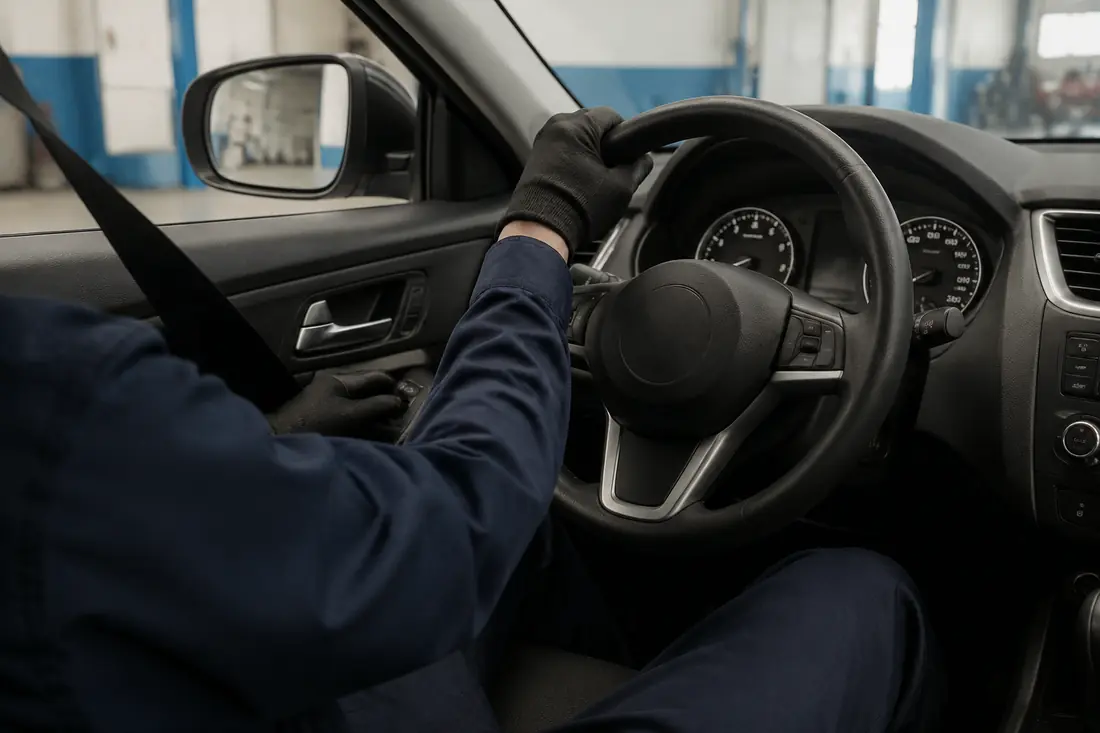
Do not attempt to tighten steering fasteners, work beneath an unsupported vehicle, disconnect safety-related modules, open hydraulic lines, or reproduce a severe symptom on public roads. If control feels uncertain, stop using the car and describe where it is parked so recovery or the next safe step can be discussed.
If the vehicle is stable and stationary, note the dashboard message, the side and direction of any noise, whether the issue is present cold or warm, and any recent event. A short video of a warning message or clearly audible sound can help, but do not hold a phone while driving. Keep previous invoices and alignment reports available because they may show which components or settings changed.
Remove loose items that could create misleading cabin noises. Do not wash away a suspected fluid leak immediately before inspection. Confirm the correct tire pressures from the vehicle information label only if it is safe to do so. These steps preserve clues without turning the owner into the diagnostician.
Preserve the clues, but do not reproduce a loss-of-control symptom for the appointment.
Special diagnostic situations
Some Steering Faults Need A Different Test Strategy
The test plan changes when the fault depends on temperature, impact history, vehicle configuration, voltage, load, steering angle, or road surface.
Intermittent Conditions
An intermittent complaint may disappear after the vehicle is switched off, the battery recovers, temperature changes, or the road surface changes. Freeze-frame records, event timing, voltage history, and a precise driver description become especially valuable. “No fault found today” should identify the conditions tested and should not be presented as proof that the original event was imagined or permanently resolved.
Post-Collision Concerns
A curb or crash can affect a wheel, tire, knuckle, tie rod, steering gear, subframe, suspension pickup point, column, sensor calibration, or body structure. Alignment numbers can sometimes be adjusted into range while a damaged or displaced component remains. Impact direction, repair records, structural evidence, and side-to-side measurements help define the next investigation.
Modified Configuration
Modified wheel diameter, tire width, offset, suspension height, steering coding, or nonstandard parts can change effort, tramlining, turning clearance, sensor interpretation, and alignment. The report should separate a verified defect from behavior created by the configuration. Returning a vehicle to a compatible specification may be part of the recommendation.
Conditions That Can Hide The Fault
A useful follow-up plan names the condition to capture, the safe method, and the measurements required. It does not ask the owner to provoke loss of control.
Driver questions
Steering diagnostic questions answered
Can I drive with a power steering warning light?
A warning may mean assistance is reduced or could change. If the wheel is heavier than normal, assistance is intermittent, other warnings appear, or control feels different, stop safely and arrange assessment or recovery. A light with apparently normal steering still needs timely diagnosis because stored information alone cannot establish continuing safety. The dashboard warning light diagnosis guide explains why the symbol and related modules matter.
Does a pull always mean the wheel alignment is wrong?
No. Tire pressure or construction, road crown, brake drag, suspension condition, ride height, impact damage, steering-center calibration, and alignment can all contribute. Tire and mechanical checks should come before an adjustment when the history or symptoms indicate another cause.
Why is the wheel heavy only when parking?
Power assistance is most noticeable at low speed, so low hydraulic pressure, an electrical supply issue, motor or sensor fault, steering gear friction, low tire pressure, or a model-specific assistance strategy may become clearer while parking. Diagnosis must distinguish assistance loss from mechanical binding.
Can a weak battery affect electric power steering?
Yes. Electric assistance depends on voltage and current, and some faults arise during starting or charging-system problems. Battery condition, charging output, connections, grounds, and stored voltage history may need evaluation before an expensive steering component is condemned.
What if there are no fault codes?
Mechanical wear, tire problems, alignment, hydraulic issues, noises, and some intermittent conditions may not set a diagnostic code. A scan is one source of evidence. Physical inspection, measurements, symptom reproduction, and service information remain important.
Will replacing the steering rack solve every leak or knock?
No. Fluid can travel from hoses or connections, while knocks can come from mounts, joints, suspension, driveshafts, stops, or body contact. The source must be traced and movement observed before replacement is justified.
Is calibration always required after alignment?
Requirements vary by vehicle and work performed. Some systems require steering-angle initialization or driver-assistance calibration after specified repairs or geometry changes. The exact procedure should be checked using the VIN and vehicle information rather than assumed.
Can mobile diagnostics finish the job?
Mobile inspection can identify many visible, electrical, and static conditions and can make a recovery decision. Speed-related behavior, alignment measurement, lift inspection, wheel balancing, hydraulic tests, and certain calibrations may need a workshop.
Describe the steering change before choosing a repair
For car steering diagnostics Dubai motorists can book, send the make, model, year, VIN if available, exact symptom, warning message, recent work, and current vehicle location. If steering control is uncertain, do not drive the car to an appointment.