
Car airbag diagnostics in Dubai
Arrange airbag diagnostics for an SRS warning, a restraint-system message or concerns about previous deployment or collision repairs. Inspector reviews the warning, supported scan data and accessible wiring and components. Further testing may be needed to confirm the cause before replacing parts.

What the airbag light means
The SRS or airbag lamp normally performs a self-check when the ignition is switched on. The exact lamp sequence varies by model. A light that stays on, flashes, fails to appear during its expected self-check or returns after going out needs model-specific investigation. The warning means the restraint controller has detected a condition or cannot complete an expected check. It does not tell the driver which component failed.
Do not assume every airbag has stopped working, and do not assume the system is ready because the light was cleared. The responsible next step is to preserve the fault record, identify the vehicle specification and diagnose the detected circuit or condition using the correct repair information.
Light remains on
Record when it appears and whether any passenger-airbag or seat-belt message appears with it.
Light is intermittent
Note seat movement, steering angle, road vibration, temperature or recent interior work that changes the warning.
Light was recently cleared
Ask what repair was completed and keep the pre-clear scan or invoice. Lost evidence can make an intermittent fault harder to trace.
What car airbag diagnostics involve
The airbag system connects airbags, crash sensors, seat-belt pretensioners, seat and buckle inputs, steering-wheel connections, control modules and related wiring. The exact arrangement varies by vehicle, so one SRS warning can have several possible causes. The inspection follows the stored evidence and visible condition instead of assuming that the airbag module or sensor named in a code is faulty.
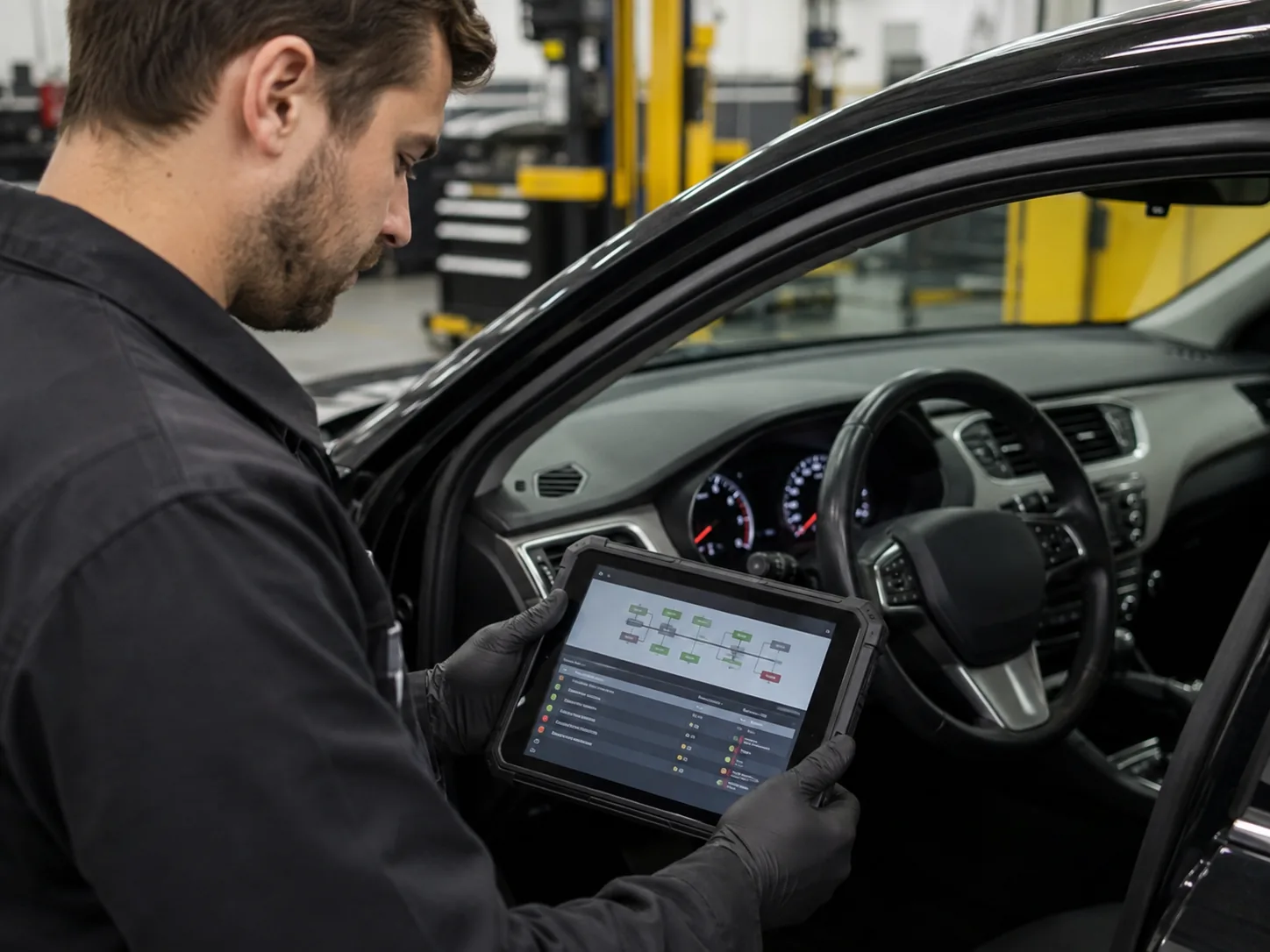
Useful diagnosis moves from the controller’s evidence to the affected circuit. A technician first confirms the complaint and vehicle specification. The scan record is preserved before codes are cleared. The fault description, status and freeze-frame or event information are read where the vehicle provides them. Connectors, wiring routes, relevant trim, prior repair areas and power-supply conditions are then checked according to the identified fault and manufacturer procedure.
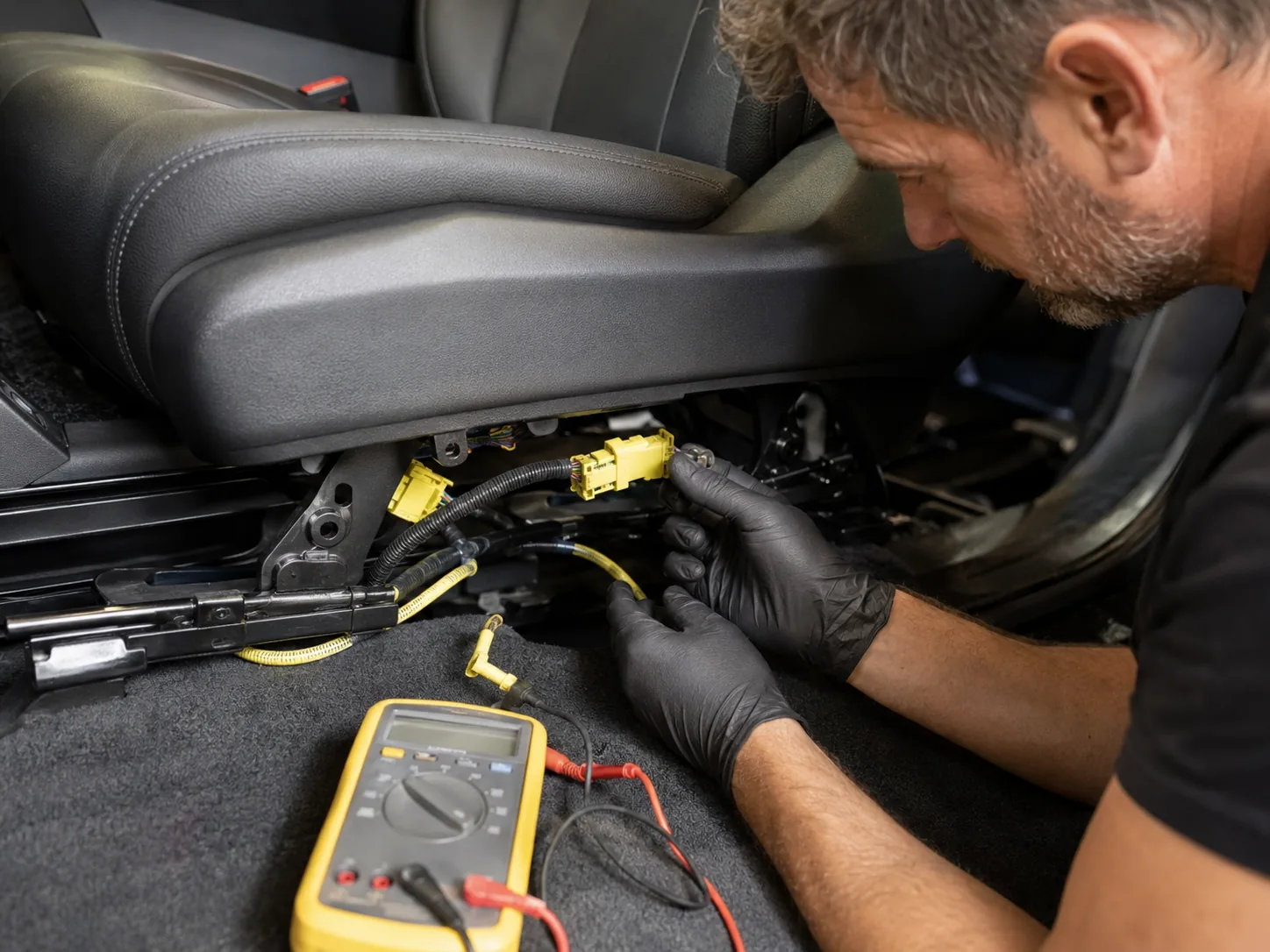
Resistance, voltage, continuity or substitute-load testing must follow model-specific safety instructions. Airbag and pretensioner circuits contain pyrotechnic devices and should not be tested with improvised methods. The diagnostic goal is a supported conclusion: what the vehicle reported, what was inspected, what was measured, what remains inaccessible and what action is justified.
When airbag diagnostics are needed
The same dashboard symbol can follow a seat repair, weak electrical supply, steering-wheel fault, previous collision or an active component problem. The booking brief should describe what changed before the warning appeared.
SRS light or restraint message
A steady or flashing lamp, “restraint system” message or passenger-airbag status warning requires the exact ignition-cycle behavior and message wording to be recorded.
Warning after seat movement
Movement can change tension at under-seat connectors or harnesses. Diagnosis should confirm the stored circuit before touching a connector or assuming the seat is the cause.
Horn or steering controls also fail
A clockspring or steering-column connection may be relevant when the airbag warning appears with steering-wheel electrical symptoms, but testing must separate the circuits.
Warning after battery work
Low voltage, battery disconnection or jump-start history can add context. Stored supply-voltage faults should be distinguished from an active restraint-circuit fault.
Vehicle had previous collision repairs
Deployment history, replaced trim, seat belts, module status, wiring repairs and component identity may need review. A clear lamp alone cannot authenticate the repair.
Passenger-airbag status behaves unexpectedly
The occupant classification system, seat sensor, seat installation, calibration state or related wiring may be involved. The correct response depends on the model and fault record.
One warning can involve many components
The dashboard lamp represents a monitored network, not a single replaceable “airbag sensor.” Vehicle specification determines which elements are fitted and how they communicate.
Restraint control module
Stores system faults and manages deployment decisions from the information available to it. Deployment or crash-data questions require model-specific procedures.
Airbag modules and inflators
Driver, passenger, side, curtain, knee or other modules vary by vehicle. External condition and identity evidence may be visible, while internal integrity usually is not.
Pretensioners and buckles
Pyrotechnic pretensioners, buckle switches and belt status can be part of the restraint strategy. A previous crash may affect belts even when an airbag did not deploy.
Seat and passenger detection
Occupant classification, seat-position sensing and passenger-airbag suppression logic can be sensitive to seat components, calibration and vehicle-specific installation.
Clockspring and connectors
The rotating connection behind the steering wheel may carry the driver-airbag circuit along with horn or steering controls. Combined symptoms provide useful context.
Crash and pressure sensors
Sensor type and location differ by platform. A sensor-related code still requires circuit, mounting, damage and repair-information checks before replacement.
The airbag diagnostic sequence
The sequence protects evidence and reduces parts guessing. Actual tests change with the model, code, access and safety instructions.
Confirm identity and complaint
Record VIN, model, year, market specification, warning wording, ignition-cycle behavior, recent repairs, battery events and collision history supplied by the owner.
Preserve the original scan
Use compatible equipment to identify module communication and record active, stored or history codes before clearing anything. Save status information where supported.
Map the affected circuit
Use the code description and correct repair information to identify related modules, connectors, power feeds, grounds, harness routes and required precautions.
Inspect and test safely
Check accessible installation, prior repair evidence and relevant electrical conditions. Any circuit test or disconnection must follow model-specific isolation procedures.
Verify after authorized work
After the identified repair is completed, repeat the scan and warning-light check, confirm communication and document remaining codes or restrictions.
What scan data proves and what it does not
A compatible scan may establish
- Whether the restraint module communicates during the appointment
- The diagnostic trouble code number, description and available status
- Whether a fault is active, stored, intermittent or historical when the module distinguishes those states
- Relevant supply-voltage, buckle, occupancy or deployment-status information where supported
- Whether the code returns after an authorized repair and verification cycle
A scan alone cannot establish
- That the named component is definitely the failed part
- That every airbag and pretensioner is genuine, internally intact and correctly installed
- That concealed wiring and connectors are undamaged
- That the vehicle has never had a collision or deployment
- That clearing all codes proves future deployment performance
- That a recall or market-specific campaign has been completed without checking the proper source
Follow the circuit, not a parts list
Under-seat harness or connector concern
Seat movement, upholstery work, water, stored items or previous disconnection can affect a harness. The code must identify the relevant circuit, and safe isolation procedures apply before inspection or reconnection.
Clockspring or steering-wheel path
A driver-airbag circuit code may appear with horn, steering-button or steering-angle symptoms. Those clues help define the route but do not replace continuity and connector checks under the correct procedure.
Supply voltage or communication fault
A weak battery event can leave historical information, while an active module communication problem may involve power, ground, network wiring or the module itself. Current electrical condition matters.
Occupant classification problem
Passenger-seat sensors and calibration logic vary widely. Seat replacement, cushion work, accessories, wiring or an actual sensor fault may be relevant. The repair path must match the vehicle.
Previous deployment or module status
After a collision, the restraint controller may retain crash-related information and deployed components may require replacement. Resetting terminology should never hide the need for correct parts and documented repair.
Impact sensors and mounting points
A sensor fault can arise from the sensor, connector, harness, mounting condition, corrosion, collision damage or incompatible replacement. Location and required replacement rules come from model-specific information.
Inspect the repair, not only the warning light
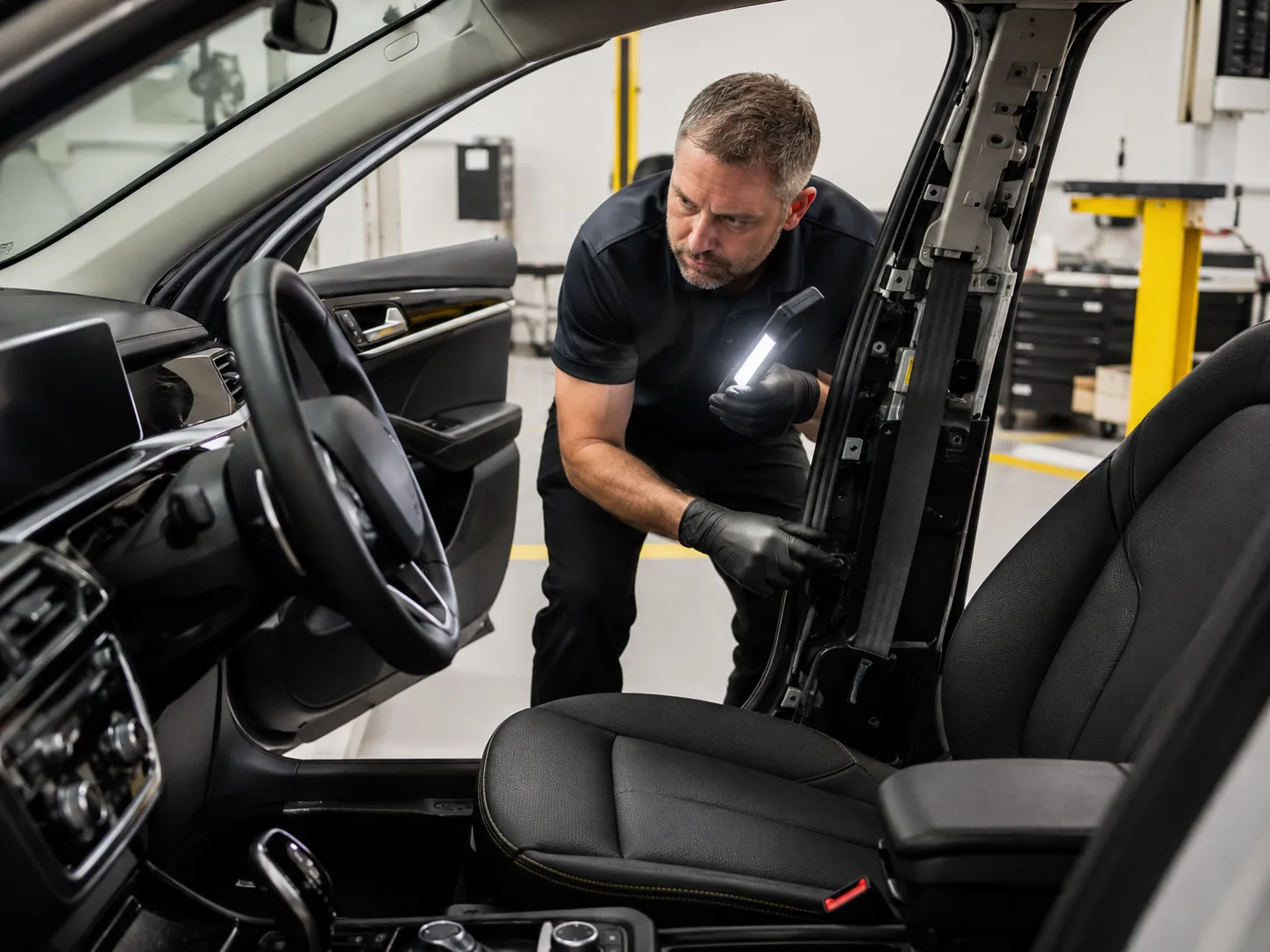
After known or suspected deployment, check which airbags, seat belts and pretensioners were affected and what repairs were completed. Body repairs, replaced trim, module records and invoices for fitted parts can help identify work that still needs verification.
A warning lamp that currently goes out cannot prove that every deployed component was replaced correctly. Resistors, damaged connectors, incorrect modules or other forms of tampering may alter what the controller sees. Some evidence is visible; some requires trim removal, part-number verification or specialist dismantling outside a non-invasive inspection.
For a used car, ask for invoices and photographs from the collision repair. Check manufacturer or official recall information using the VIN and the correct market source. A general diagnostic page should not claim access to a complete accident, insurance or recall database.
Read SRS findings by priority
An airbag diagnostic report should separate observed facts from the interpretation and next action. It should identify the vehicle, warning state, scan coverage, codes and statuses, tests completed, accessible physical evidence, restrictions and whether the fault remained active. It should not convert one code into an unsupported replacement instruction.
Active restraint warning
Record the condition and arrange model-specific diagnosis. The page does not declare the vehicle safe to drive or predict which restraints remain available.
Supported circuit fault
When scan and test evidence identify a circuit problem, the report should state the repair or specialist test needed without guessing beyond the evidence.
Previous deployment concern
Request repair records and escalate concealed component or part-identity checks. A clear warning lamp is not proof of correct collision repair.
Access or communication gap
Unsupported modules, low voltage, locked trim, seller restrictions or unavailable repair history should be written as limits, not silently treated as a pass.
Choose mobile or workshop diagnostics
The right setting depends on the fault and required evidence. Customers searching for airbag diagnostics near them can send the vehicle details, warning photo, collision history and location first. Inspector can then confirm whether a mobile fault record is suitable or whether the Al Quoz 4 workshop is needed for controlled access, safe isolation, electrical testing or repair verification.
Mobile diagnostic inspection
A mobile visit can be useful for recording the warning state, vehicle identity, disclosure, compatible scan results and accessible installation evidence where the location is safe and the battery condition allows testing.
- Useful for an initial fault record and used-car screening
- Depends on diagnostic compatibility and stable electrical supply
- Limited when trim removal, programming, calibration or controlled workshop tests are needed
- Seller permission and access must be confirmed in advance
Workshop diagnostic checks
A workshop is more appropriate when the circuit requires safe isolation, trim access, electrical testing, seat work, module programming, calibration, repair verification or coordination with collision-repair evidence.
- Better access to wiring routes and protected connectors
- Supports controlled electrical supply and model-specific tools
- Allows authorized repair and repeat verification in one setting where capability is confirmed
- Still does not make inaccessible internal component condition visible without the required dismantling
Airbag modules, inflators and pyrotechnic pretensioners are safety-critical components. Do not unplug, probe, dismantle or substitute these circuits without the correct procedure, equipment and repair information.
What changes cost and time
A fixed universal airbag diagnostic price can be misleading because a scan-only record and a circuit investigation are different scopes. The quotation should identify the vehicle and the work included before a number is relied on.
Cost and appointment time can change with module access, diagnostic compatibility, the number and status of faults, battery condition, intermittent behavior, previous collision repairs, trim removal, electrical testing, replacement-part verification, programming, calibration and repeat checks after repair.
Ask whether the quotation covers diagnosis only or also includes dismantling, repair, replacement parts, programming, calibration and post-repair verification. If a third-party body shop or brand specialist must complete part of the work, that boundary should be clear.
- Share the VIN, make, model and year
- Photograph the warning message and ignition-cycle behavior
- Disclose previous deployment, seat, steering-wheel or dashboard work
- Send existing scans, repair invoices and part details
- Confirm whether the vehicle can be moved safely and legally

Prepare for the appointment
Small choices before the inspection can determine whether the original fault remains available to diagnose.
Do not clear the warning
Avoid disconnecting the battery or using a scan tool to erase the SRS record solely to turn off the lamp. Keep any existing scan report.
Describe the exact trigger
State whether the warning followed seat movement, cleaning, upholstery work, battery replacement, a steering repair, water entry or a collision.
Bring repair records
Provide collision invoices, photographs, part invoices, programming records and details of any airbag, seat belt, seat, dashboard or steering-wheel replacement.
Keep the vehicle unchanged
Do not move seats repeatedly, disturb under-seat wiring or remove trim before the appointment unless a qualified repair process requires it.
Confirm diagnostic access
Ensure the battery is sufficiently charged, the vehicle is accessible and the owner or seller permits scanning and the agreed physical inspection.
State the decision
Tell Inspector whether you need an initial warning diagnosis, used-car evidence, post-repair verification or a scope for specialist repair.
Airbag diagnostic questions
These answers define what the warning, scan and inspection can establish. The vehicle’s repair information remains authoritative for its exact system.
For a broader electronic investigation, see car computer diagnostics. Buyers who need the whole vehicle assessed should use a pre-purchase car inspection.
For information on airbag operation, recalls and replacement risks, read the NHTSA airbag guidance. Vehicle-specific repair information and the correct market recall source still govern the car being inspected.
Can I drive with the airbag warning light on?
An SRS warning means the system has detected a problem, but it does not show which protection remains available. Follow the vehicle handbook and arrange diagnosis for the exact model. Seek advice before moving a car with collision damage, exposed wiring, a burning smell, water intrusion or another urgent concern.
Will an OBD scanner read airbag faults?
A basic emissions-focused OBD reader may not communicate with the restraint module. Airbag diagnostics require equipment and software that support the vehicle’s SRS controller and its fault descriptions. Even a compatible code reader only reports controller evidence. Physical and electrical checks may still be needed.
Does an airbag code identify the failed part?
Not necessarily. A code often identifies a circuit, signal or condition. The cause can be the named component, a connector, wiring, power supply, ground, installation issue, incompatible part or control-module problem. Diagnosis follows the code through the model-specific circuit before parts are recommended.
Can the airbag light simply be reset?
A reset may clear historical information when the underlying condition has been corrected and the procedure permits it. Clearing an active fault without diagnosis does not repair the circuit, and the warning may return. Preserve the original scan before any authorized reset.
Why did the light appear after moving a seat?
Seat movement can change the position or tension of wiring and connectors beneath the seat, but that is only one possibility. Occupant sensing, buckle, side-airbag and pretensioner circuits may run through the seat area. Read the stored fault first and use the correct isolation procedure before touching connectors.
What should be checked after airbag deployment?
The required replacement list depends on the vehicle and collision. Relevant items may include deployed airbag modules, pretensioners, belts, control-module status, sensors, trim, wiring and mounting areas. Repair records and part identity matter. Manufacturer repair information should determine the exact replacement and programming procedure.
Can diagnostics prove replacement airbags are genuine?
No. A scan can show what the controller reports; it cannot authenticate every concealed inflator or module. Part labels, invoices, supplier records, physical inspection and model-specific verification may add evidence. Some checks require dismantling. NHTSA has documented serious risks from substandard replacement inflators, which is one reason previous deployment history deserves careful review.
Does the passenger airbag OFF light always mean a fault?
No. Passenger-airbag status behavior depends on the vehicle, seat occupancy, occupant classification and operating logic. Unexpected behavior, an SRS warning or a related fault code requires the correct manual and diagnostic procedure. Do not test the system by placing a child or unsuitable load in the seat.
Can a pre-purchase inspection include an SRS scan?
It can when diagnostic scanning is included in the agreed package and the vehicle supports the equipment used. Confirm the scope before booking. A used-car check should also look for accessible collision-repair and restraint-installation evidence because a scan alone cannot prove the history or identity of every component.
How do I request car airbag diagnostics in Dubai?
Send the make, model, year, VIN where appropriate, warning photograph, when the issue began, recent seat or electrical work, known collision history and your location. Inspector can then define whether the first step is mobile evidence collection, workshop diagnosis, a wider accident damage inspection or referral for model-specific repair.
Arrange car airbag diagnostics in Dubai
For car airbag diagnostics in Dubai, start with the exact vehicle, warning behavior and recent work. Inspector can define the first diagnostic scope without pretending that every SRS light needs the same scan, part or setting.
Send the make, model, year, location, warning photo and any collision or repair records.